Resources / Balance Calibration
By The Bio Matrix Team · September 12, 2024
Key Takeaways
Laboratory balances are not all created equal. Selecting the right type for your application — and keeping it properly calibrated — directly affects measurement accuracy, compliance, and the reliability of your data. This guide covers the key differences between analytical and precision balances, their respective applications, and what proper calibration and verification look like for each.
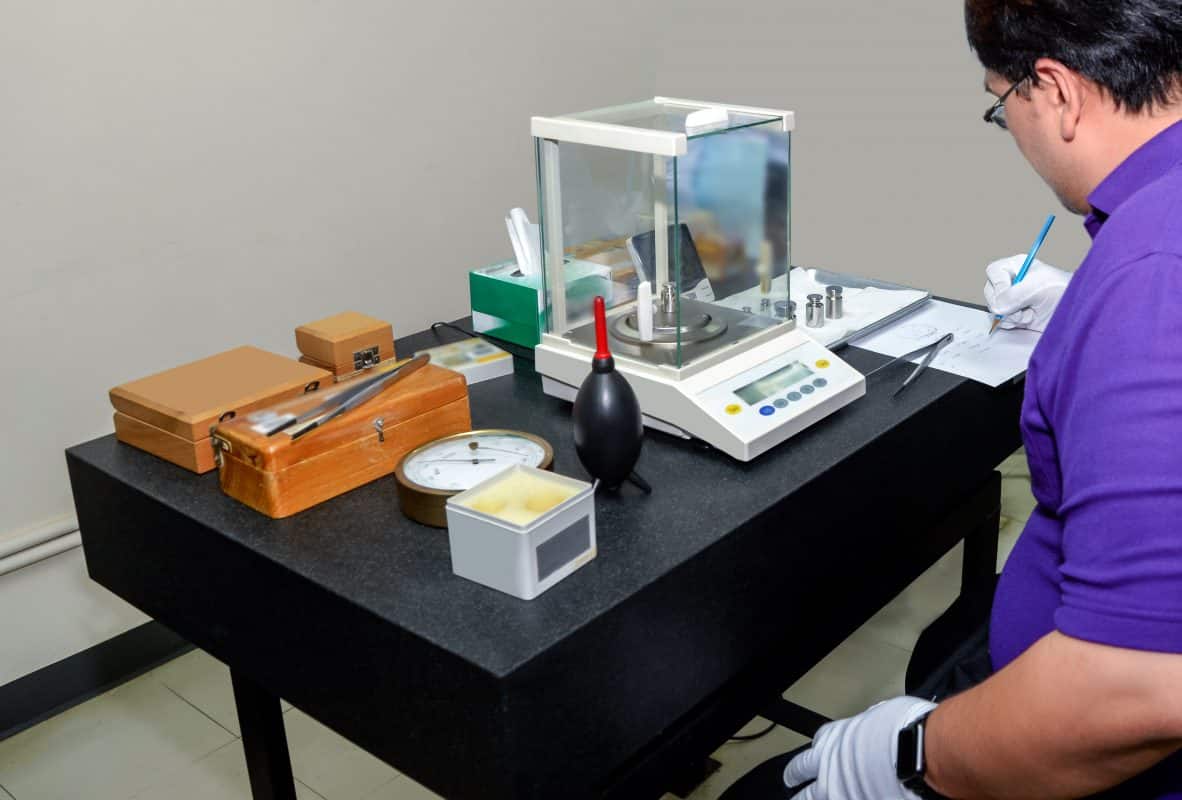
Analytical balances are the gold standard for high-sensitivity weighing. They offer:
These instruments are essential in pharmaceutical research, chemistry, and any setting where minute mass differences have meaningful downstream consequences.
Precision balances combine accuracy with greater practicality for routine work. They feature:
These are well-suited for routine laboratory weighing, QC checks, and educational settings where extreme precision isn't a requirement.
The broader laboratory weighing ecosystem also includes top-loading balances for general purpose use, microbalances for ultra-precise measurements below the analytical range, and moisture analyzers for determining sample moisture content.
| Feature | Analytical Balance | Precision Balance |
|---|---|---|
| Readability | 0.0001 g or better | 0.001 g to 0.01 g |
| Maximum Capacity | Few hundred grams | Several kilograms |
| Draft Shield | Required | Rarely needed |
| Sensitivity | Microgram-level | Milligram-level |
| Primary Use | High-precision analysis | General / routine weighing |
| Calibration Frequency | More frequent (higher sensitivity) | Per manufacturer guidelines |
Sensitivity refers to the smallest mass change a balance can reliably detect. Analytical balances detect microgram-level changes; precision balances detect milligram-level changes. This distinction matters most when working with trace amounts or when a small weighing error would propagate into a significant downstream result.
Accuracy describes how close a reading is to the true value. Analytical balances provide the highest accuracy for critical measurements. Precision balances are sufficient for general lab work where microgram-level resolution isn't required. Both types drift over time due to mechanical wear, environmental factors, and use — which is why calibration is not optional for either.
These terms are sometimes used interchangeably, but they are not the same:
The process of adjusting the balance against certified reference weights to correct for measurement error. Calibration requires traceable standards and produces documented results — typically a NIST-traceable certificate that serves as audit evidence. Analytical balances generally require more frequent calibration due to their higher sensitivity.
Periodic testing between calibrations using control weights to confirm the balance is still reading within acceptable tolerances. Verification does not replace calibration — it confirms the calibration is still holding. Results should be documented and retained as part of your lab's instrument records.
For regulated labs, both calibration and verification records are audit evidence. CAP, CLIA, GLP, GMP, and FDA inspectors routinely request calibration certificates and verification logs for laboratory balances. Our balance calibration service produces NIST-traceable certificates with fields formatted to common calibration documentation requirements, suitable for use in regulated environments.
Academic labs often need to support both advanced research and undergraduate instruction. A practical approach:
In both cases, a regular calibration schedule and documented verification program are needed to maintain instrument reliability — and to satisfy any institutional or accreditation requirements.
The choice between an analytical and precision balance comes down to the sensitivity your application requires. Analytical balances are indispensable for critical, trace-level measurements. Precision balances handle routine weighing with practical capacity and durability. In most well-equipped labs, both types have a role.
Regardless of type, both require regular professional calibration and a documented verification schedule. If your lab's balances are overdue for calibration — or if you're not sure when they were last serviced — our laboratory balance calibration service produces NIST-traceable certificates for analytical and precision balances, accepted by CAP, CLIA, GMP, and FDA auditors. Balance calibration can often be scheduled at the same visit as pipette calibration — one technician, one documentation package.
Can a precision balance replace an analytical balance for complex research?
Generally, no. Analytical balances provide far greater sensitivity, which is critical for advanced research requiring sub-milligram precision. A precision balance is appropriate for routine work, but not for applications where microgram-level accuracy matters.
Are draft shields really necessary for analytical balances?
Yes. Because analytical balances detect microgram-level changes, they are highly susceptible to air currents, vibration, and even breath from the operator. Draft shields are not optional — they are an integral part of the instrument.
How often should I calibrate my laboratory balance?
Calibration frequency depends on usage level, environmental conditions, and your regulatory requirements. Analytical balances generally need more frequent calibration than precision balances due to their higher sensitivity. Always follow the manufacturer's guidelines and your lab's SOP — for regulated environments, annual calibration at minimum is typical, with more frequent checks for high-use instruments.
Can students accurately operate analytical balances in university labs?
Yes, with proper training. Analytical balances require technique discipline — draft shield use, zeroing between samples, avoiding vibration sources — that students need to learn before relying on them for quantitative work. Precision balances often serve as an effective stepping stone.
Calibration Reminder Service
Never miss a calibration due date.
We'll notify you when a technician is scheduled in your area — so you can request service in one click.
NIST-traceable balance calibration — on-site or mail-in. Often scheduled at the same visit as pipette service.